Neurointensive care
Our vision: Personalized intensive care for critically ill neurological patients

Prof. Dr. med. Konstantinos Dimitriadis
Why is our research important?
Every year, thousands of patients with strokes, cerebral hemorrhages, traumatic brain injuries, epilepsy, encephalitis, or meningitis need treatment in intensive care. This phase is a huge challenge for the patients and their families – with potential consequences such as lasting disabilities, cognitive impairments, or even death.
At the same time, doctors and nurses face complex decisions and need specialized methods to guarantee optimal care. Our research starts right here: We develop innovative diagnostic and therapeutic concepts to provide the best possible treatment for neurological intensive care patients and to increase their chances of survival without permanent damage.
Our research focuses on:
1. Neuromonitoring: Precise monitoring to avoid complications
In order to identify the progression of diseases at an early stage, we use state-of-the-art monitoring methods, including:
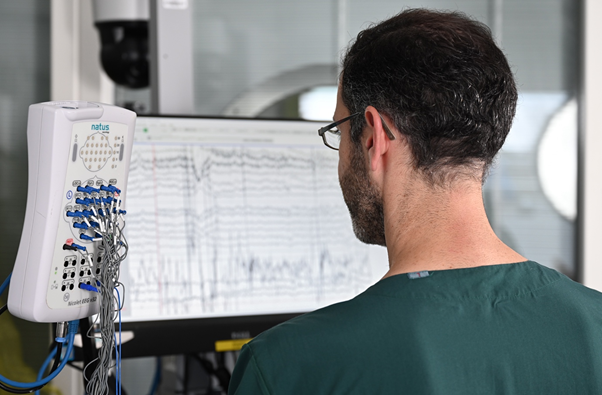
- Continuous EEG measurements to detect signs of seizures or changes in consciousness.
- 3D ultrasound to visualize brain structures at the patient’s bedside without any additional stress for the patient.
- Artificial intelligence to analyze complex diagnostic data more quickly and predict complications at an early stage.
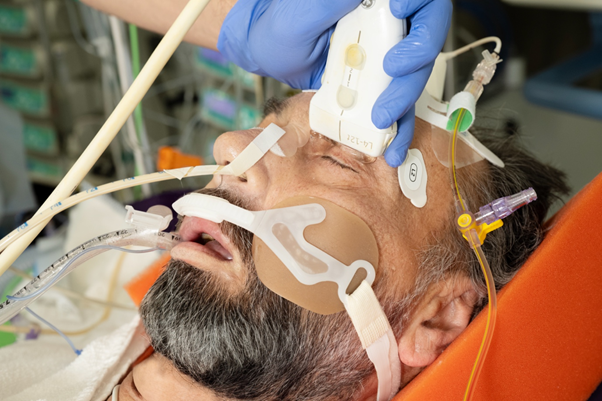
Your donation helps
to further develop these innovative technologies and investigate their therapeutic relevance for patients.
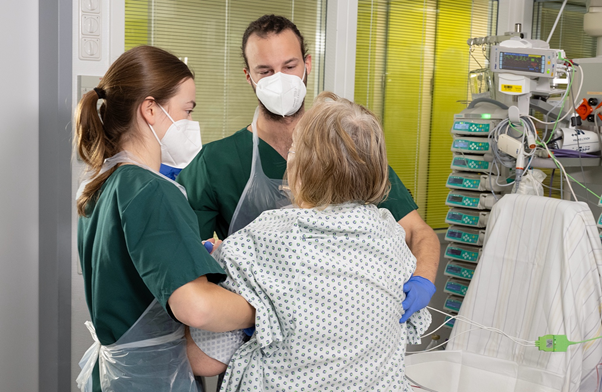
2. Muscle loss in the intensive care unit: Understanding the causes – Finding solutions
Long stays in intensive care often lead to significant muscle loss, which makes rehabilitation more difficult. We systematically research factors such as nutrition, movement, the microbiome, or medication and use state-of-the-art measuring methods such as:
- 3D ultrasound for muscle analysis
- Indirect calorimetry for individual nutrition planning
- Movement sensors to monitor activity
Preliminary results already prove the major significance of mobilization and provide crucial information about optimal calorie intake.
Donations make cost-intensive analysis of biological samples and the further development of AI-supported diagnostic procedures possible.
3. Prognosis forecasting for coma patients: Who has a chance of recovering?
Patients with severe brain damage can remain in a coma for a long time. One of the biggest challenges is differentiating with certainty between who can recover and who has suffered irreversible damage.
Our approach:
- Using EEG and digital pupillometry for more accurate predictions
- AI-supported analysis of large amounts of EEG data combined with imaging
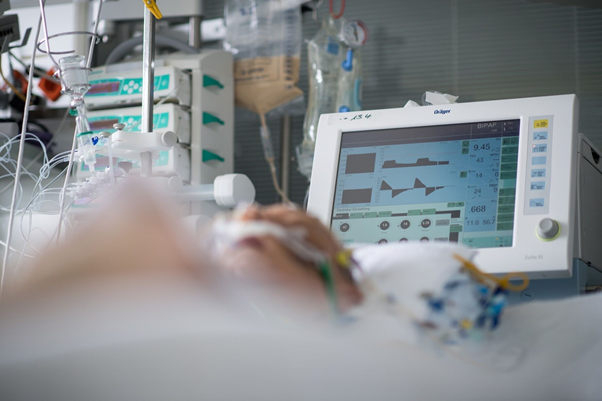
Donations support the further development of these analysis algorithms.
4. Epilepsy and Status Epilepticus: Improving treatment of life-threatening seizures
An uncontrolled, sustained epileptic seizure (status epilepticus) is a medical emergency with a high mortality rate. However, there are so far only limited science-based therapeutic approaches.
Our research achievements:
- We were able to identify first effective therapeutic approaches using data analysis.
- We are currently developing mathematical models for the accurate calculation of drug dosages.
- The next phase consists of large clinical trials to test the efficacy.
Your donation helps us to research new therapeutic methods and give patients a better prognosis.
5. Training: Expertise saves lives
Working in an intensive care unit requires extensive knowledge, practical skills, and an experienced team. Despite best intentions, a lack of training can lead to errors in treatment.
Our contribution:
- Development of standardized training concepts based on Entrustable Professional Activities (EPAs)
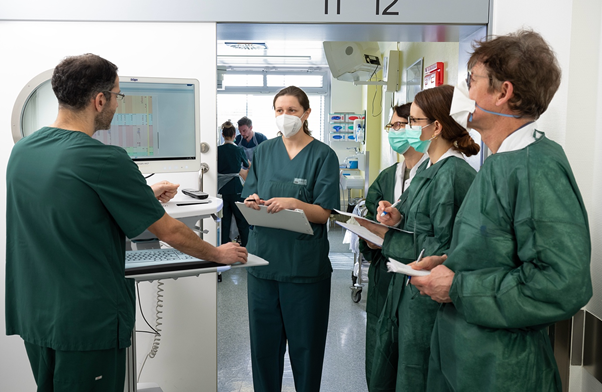
- Simulation training to improve the team’s emergency response
- Targeted research on the effectiveness of this training
Donations help us to continue to develop innovative teaching methods and simulation training.
What your support can do
Your contribution goes directly to:
- Research and development of new diagnostic and therapeutic methods
- Clinical trials to improve existing treatments
- Advanced training of medical staff for better patient care
Every donation brings us one step closer to optimal intensive care for severely ill neurological patients.
Donating is easy
Bank transfer
Use the bank details below to transfer your donation directly.
Recipient: LMU München KdöR - Stiftungen@LMU
IBAN: DE16 7002 0270 0015 6232 55
BIC: HYVEDEMMXXX
Bank: HypoVereinsbank München
Reason for transfer: "Nerven bewahren" Foundation
If you need a donation receipt, please enter your full postal address in the bank transfer or send an email to nerven-bewahren@med.uni-muenchen.de
Donating online
Or use our convenient, secure online donation page. Click on the link below to send your donation.